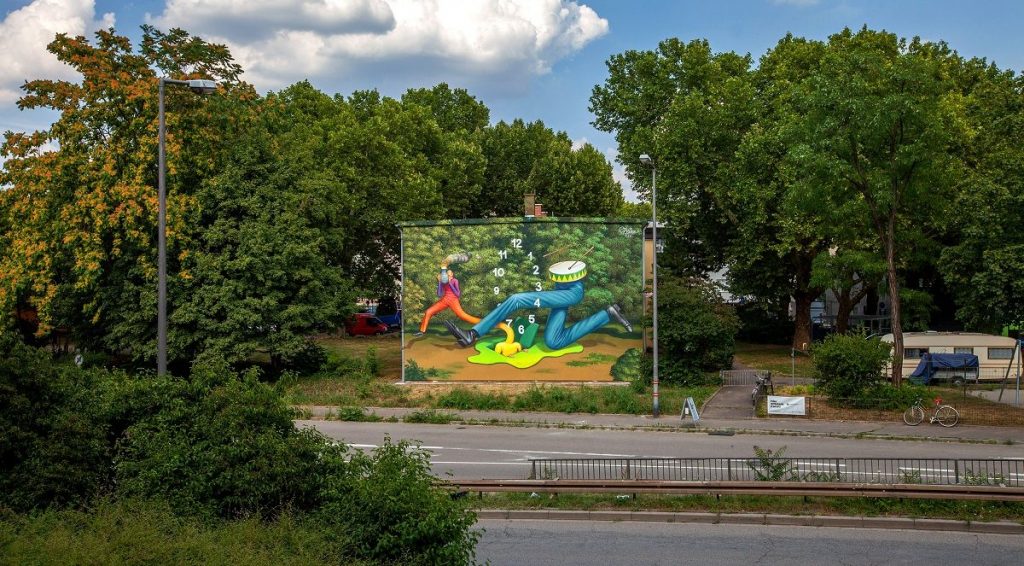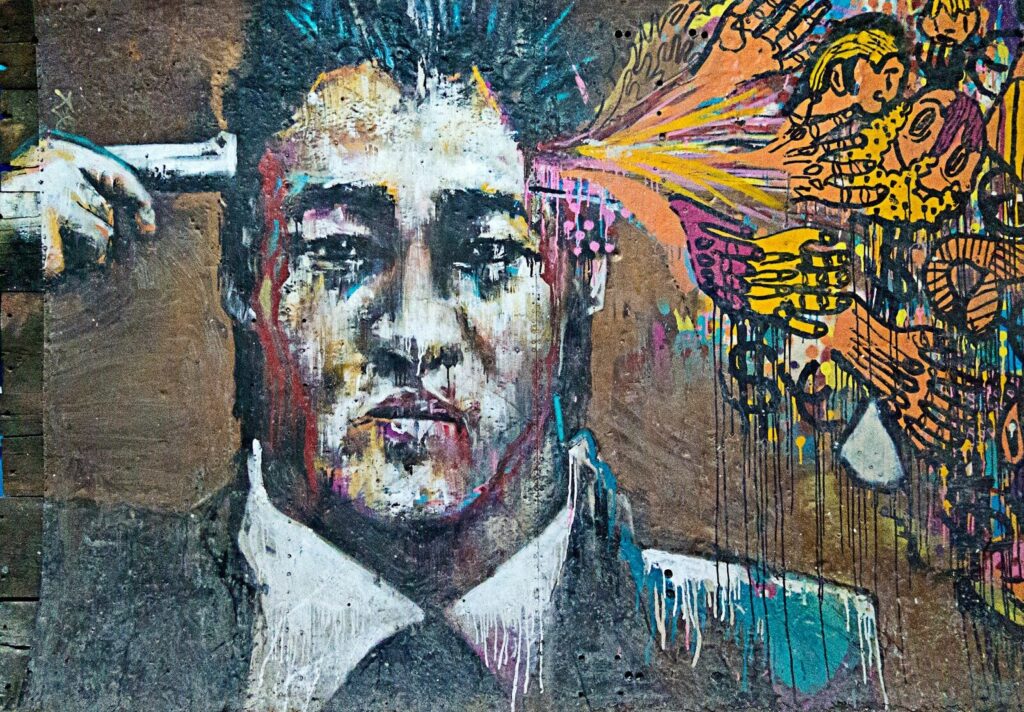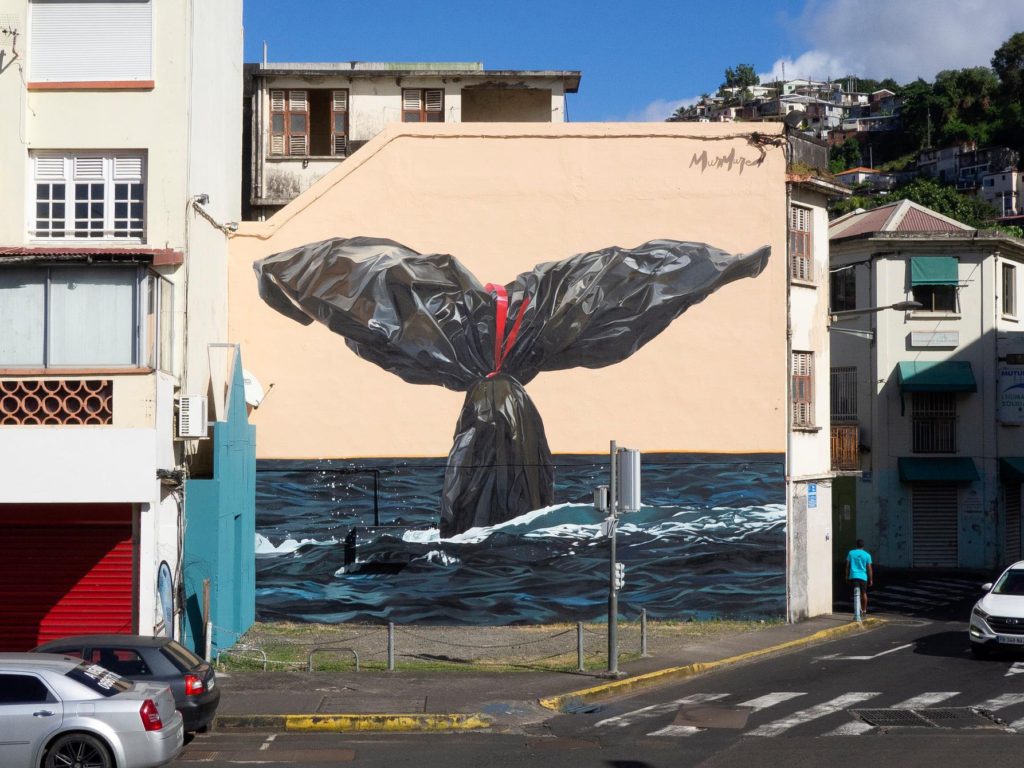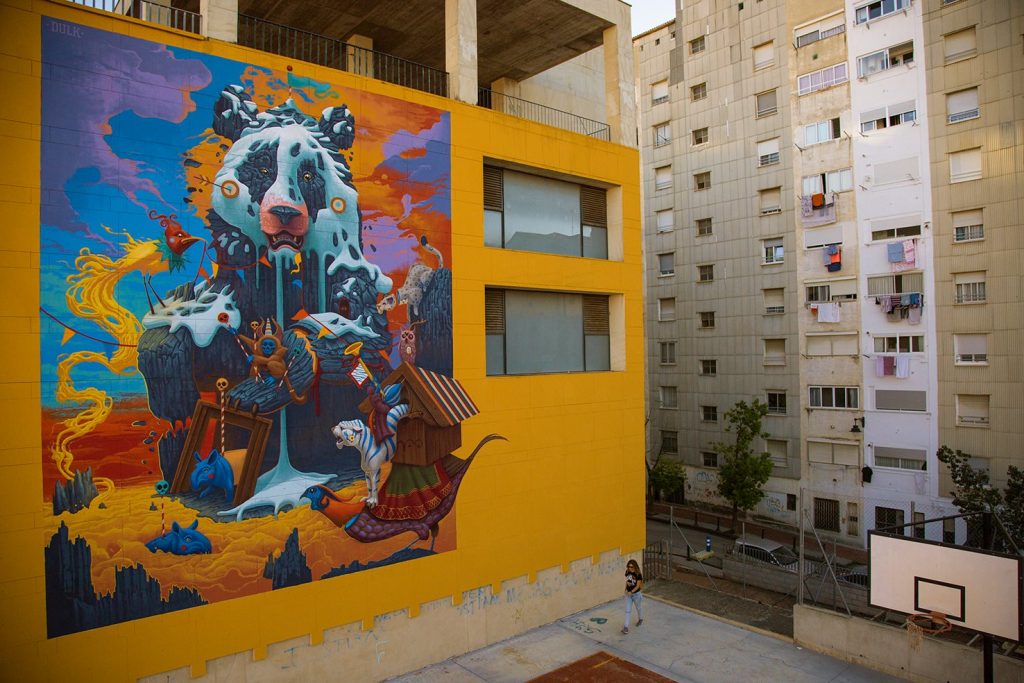


Since 2010, the French artistic duo Murmure—composed of visual artists Paul Ressencourt and Simon Roché—has been quietly restructuring how we interact with the urban canvas. Originally founded as a creative studio, the duo eventually stripped away commercial constraints to engage directly with the public, shifting their visual focus toward the raw textures of public space. Moving fluidly between playful, hyper-realistic interventions and urgent socio-environmental critique, Murmure treats brick, concrete, and fine art paper as a continuous narrative medium.Their creative philosophy relies on a delicate, evocative tension—a constant balancing act between immense formal beauty and structural discomfort. By introducing fine art precision to unpredictable city streets and adapting ephemeral street art for the technical world of traditional printmaking, Ressencourt and Roché explore themes of environmental decay, systemic inequality, and human fragility.
In this conversation, the artists discuss the studio-to-street creative process, the evolving politics of public art, and the foundational role of optimism in addressing the world’s darkest realities.

Poetics and Confrontation
Your work often balances beauty with discomfort—whether through themes of environmental collapse, social inequality, or human fragility. How do you decide when a piece should remain poetic and when it should become openly confrontational?
From our perspective, we always try to approach these subjects through a poetic lens. No matter how difficult, controversial, or provocative a topic may be, we won’t address it until we have found an angle that allows us to approach it with a certain sense of beauty. We believe this is essential if we want the message to resonate with people.

From the Streets to the Studio
In your street works, the city itself becomes part of the artwork. How does the meaning of a piece change when it moves from the street into a gallery setting or a lithograph edition?
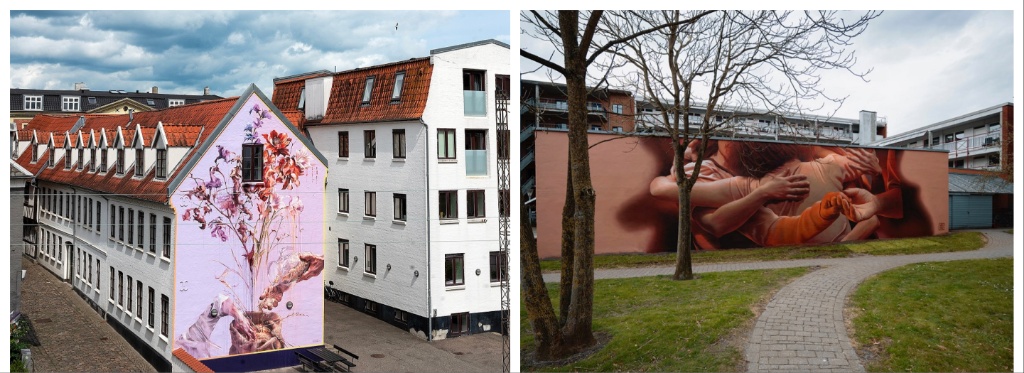
When we started in 2010, we worked exclusively in the street. Our entire visual language and creative process were conceived for urban walls. The wall itself became a narrative extension of the drawing, completing the artwork.
Since our first exhibition in 2018, however, our process has evolved. We now begin every project in the studio with research and conceptual development. This initial work may then lead to adaptations for the street—or not. All of the drawings and paintings we create for public space are produced at full scale, sometimes even at 120% of their final size. This helps give the work a strong physical presence and a sense of authenticity within the visually saturated urban environment.
So it is not really a matter of a work leaving the street and entering a gallery. Rather, it is a studio-based creative process that allows some pieces to be developed for the street, others for the gallery, and sometimes for both.

Precarious Habitats
Your recent lithograph, Precarious Habitat, feels deeply connected to themes of instability, displacement, and survival. What was the emotional or political starting point behind that work, and what conversations were you hoping it would provoke?
Social exclusion has always been a central theme in our work. Our earliest series, created in 2010, consisted of large-scale portraits of homeless people entitled Urban Muses. We pasted them throughout French cities using the same visual tools and strategies employed by advertisers, with the aim of redirecting public attention toward people who often become invisible within the urban landscape.
The semantic starting point of Precarious Habitat is Gaza. The metaphor of the snail carrying its home is closely linked to the image of children whose homes—and often their lives—have been destroyed. In many ways, the image can apply to war in general. However, in this specific case, the imbalance of power and the scale of civilian casualties, particularly among children, make the situation especially striking.

Democratizing the Art World
Many of your lithographs combine highly technical craftsmanship with urgent social commentary. Do you see printmaking and limited editions as a way to preserve street art, democratize it, or transform it into something entirely different?
For us, editions and multiples are perfectly aligned with what we love about street art. Street art is popular in the noblest sense of the word. Coming from a fine arts background, we understand the codes of contemporary art very well, but we sometimes feel that it can create an elitist or pretentious distance between the artwork and the public.
Street art, on the other hand, offers itself entirely to the public. It exists in the street where everyone can see it, touch it, and photograph it. In that sense, editions follow the same philosophy. They are more accessible and allow a wider audience to live with genuine works of art in their own homes.
Lithography, screen printing, and other printmaking techniques are also authentic artistic mediums in their own right, carrying both a rich technical tradition and a long history within the arts.

The Evolution of the Movement
Street art was once considered anti-establishment and anti-commercial, yet today cities often use murals and urban art as tools for branding and redevelopment. Do you think street artists are sometimes being used as instruments of gentrification?
Yes, absolutely.
We believe that political institutions—or more precisely, the fact that public officials are often the decision-makers behind funded public art projects—tend to push street art toward something smoother, more conventional, and more decorative, which is the opposite of its original spirit.
The positive side of this evolution is that it has made street art more mainstream, allowing many artists to make a living from their work. It is obviously much easier to get approval for a giant mural featuring a cat, flowers, or a famous personality than for an artwork carrying a strong social or political message.
That said, this phenomenon is not unique to street art. It exists in every cultural field, whether music, cinema, literature, or publishing. We can clearly see it today in France across various cultural industries. It is also one of the reasons why we continue to paste our works in public spaces without permission.

Have you ever been invited to create work somewhere and later realized that the project was more about increasing real-estate value or “cleaning up” a neighborhood’s image than supporting the local community?
I don’t think so. The distinction between improving a neighborhood to support the local community and improving it to increase its market value can sometimes be very subtle. These questions are often deeply political, and artists do not necessarily have access to all the urban planning agendas, economic interests, or long-term development strategies that may exist behind a project.
The evolution of street art over the past twenty years has been dramatic—from illegal interventions to auction houses, galleries, and luxury-brand collaborations. What have we gained through that evolution, and what have we lost?
I’m not sure we’ve actually lost anything. This is a fairly classic evolution from underground culture to mainstream culture. There will always be people who say that things were better before, but every artistic movement goes through similar transformations as it grows and reaches a wider audience.

The Artist’s Role in Times of Crisis
Your work often addresses environmental destruction and the vulnerability of ordinary people. Looking at what is happening in Gaza, Lebanon, and the broader regional tensions involving Iran, do you feel artists have a responsibility to respond politically in moments like these?
I don’t believe artists have an obligation to take a political position or address these subjects in their work. That said, I have tremendous admiration and respect for the artists who do, especially those who chose to speak out from the very beginning.
In times of war and humanitarian crisis, some artists avoid politics while others become more outspoken. Have recent global events changed the way you think about the purpose of art or the role of the artist in society?
Not really. Unfortunately, we did not need these recent events to appreciate the value of artistic engagement. As former graphic designers, we have always felt that art allows you to say more—and to say things that are more personal. In many ways, that was the reason behind our own transition from graphic design to fine art.
We wanted, and perhaps even needed, to share our vision of the world.

A Resolute Optimism
Much of your imagery seems suspended between collapse and hope. Despite everything happening globally—climate anxiety, war, displacement, and rising inequality—are you still optimistic about humanity’s future, or has your work become more pessimistic over time?
It is true that the current geopolitical climate does not encourage optimism. Nevertheless, we remain deeply and resolutely optimistic. In fact, it is precisely this optimism that we strive to convey through the aesthetic dimension of our work. The sense of beauty we bring to difficult subjects is our way of expressing hope, even when addressing the darkest realities.
Outro: The Architecture of Hope
In an era where political discourse often feels polarizing and public spaces are heavily commercialized, Murmure provides a vital alternative. Paul Ressencourt and Simon Roché do not look away from global crises; instead, they frame them with an undeniable, rigorous elegance. By forcing a visual collision between high-contrast beauty and heavy systemic truths, they remind us that art’s role is not simply to decorate our survival, but to make us actively care about it.
Ultimately, Murmure’s work functions as a quiet subversion of despair. Whether through an unsanctioned, large-scale paste-up on a cracking Parisian doorway or a meticulously pressed lithograph inside a gallery, their art insists on finding poetry amid structural instability. It is an enduring testament to their central thesis: even when the world feels suspended on the edge of collapse, beauty remains our most resilient form of hope.